01 / INTENT
Intent-first workspaces
Bring questions, decisions and business actions together in a conversational workspace.

CONNECTED INTELLIGENCE. BUILT FOR BUSINESS.
Meet the emerging AI-native business operating environment. Connect the systems you already trust, coordinate intelligent agents, and move toward personalized workspaces that adapt to your goals. Start today with governed workflows and integrations.
OUR PRODUCT VISION · EVOLVING PLATFORM
Describe an outcome rather than navigating disconnected screens. Mesh is evolving to connect business capabilities, coordinate agents and compose the right interface for each task.
Bring questions, decisions and business actions together in a conversational workspace.
Make approved operations discoverable across existing systems, with typed contracts and scoped permissions.
Combine reliable fixed screens with task-specific, AI-composed interfaces and reusable workspaces.
Let specialist agents coordinate across application boundaries while trusted services execute business operations.
Keep identity, tenant isolation, approvals, auditability and operating cost visible at every step.
Build on adaptable Solution Packs, connectors and reusable agent skills rather than replacing everything.
Product direction: Our current platform includes governed agents, knowledge retrieval and workflow foundations. Generative applications, the business capability registry and cross-application agent interoperability are planned enhancements, not generally available capabilities.
MODERNIZE WITH PURPOSE
Disconnected applications. Documents nobody can find. Teams copying the same information between screens. These are business problems worth solving.
Mesh Systems combines enterprise architecture, hands-on integration and practical AI engineering to help you reduce manual effort, improve service and modernize in manageable steps.
Connect approved APIs, databases and business applications.
Prove one workflow before expanding across the organization.
Build permissions, approvals and escalation into the solution.
WHAT WE CAN BUILD WITH YOU
From a focused assistant to connected operations, choose the capabilities your business needs.
Help teams ask questions, gather context and carry out approved tasks through a single conversational experience.
Turn approved manuals, policies and operational documents into searchable, source-backed answers.
Connect business applications and third-party services so teams spend less time moving information by hand.
Expose selected business tools through Model Context Protocol so compatible AI experiences can use them.
Combine real Agent steps, typed decision branches, scoped Knowledge and human approval in reviewable Workflows.
Start with shared workers and grow into reserved concurrency or dedicated enterprise capacity.
BUSINESS ROLES. SHARED FOUNDATIONS.
Build on reusable Customer Service, Sales and Operations templates, then configure your own knowledge, rules and approved operations.
Ground responses in approved guidance, retrieve permitted records and prepare a clear escalation when a person should take over.
Explore Solution Packs →Collect missing information, consult product knowledge and prepare reviewable summaries using approved Tools.
Configure an Agent →Coordinate requests with durable Workflows, explicit approval steps and visible execution attempts.
Explore Workflow Studio →AGENT TEAMS · WORKING IN DEVELOPMENT
Give specialist Agents distinct roles, approved Knowledge and defined responsibilities. A supervised coordinator brings their results together while the platform keeps work bounded and observable.
ENGINEERED FOR CONTROL
Our development Portal has exercised real multi-Agent model calls, scoped policy retrieval, structured fact extraction, conditional routing, human approval and rejection, and complete cited response drafts.
Availability: Validated in controlled development and UAT scenarios. Dynamic model-selected delegation, unattended email, live Web Search, durable recovery and dedicated tenant node pools remain planned or deployment-dependent.
Explore Agent Teams ↗Build with immutable Agent and Team versions, source-grounded RAG, typed Workflow decisions, native approvals, and actual execution traces. Our controlled UAT has validated agent-assisted request extraction, policy checks and reviewed customer-response drafts.
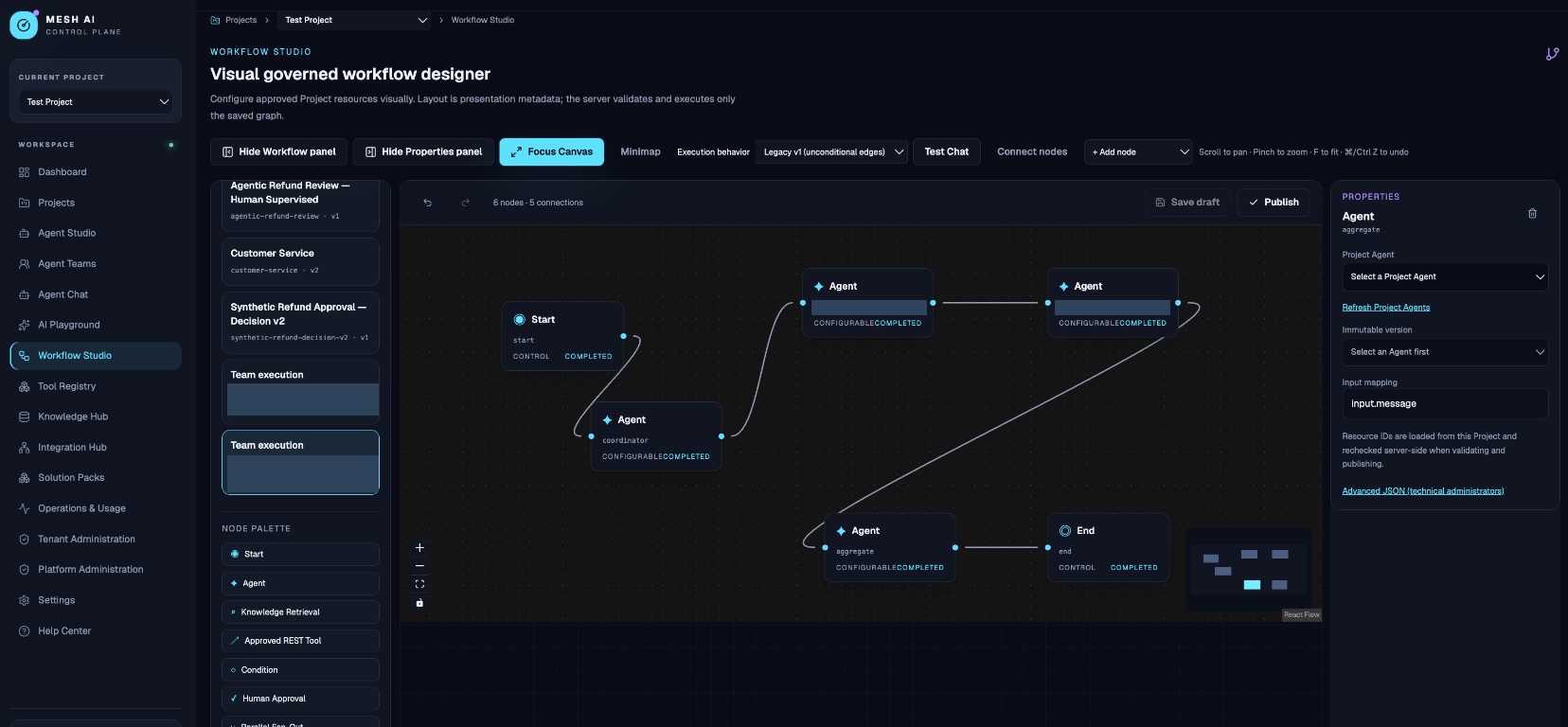
Illustrative workflow built from capabilities validated in supervised development UAT. It is not a live Portal screenshot or a claim of production availability.
Define role-specific Agents, pin versions, scope Knowledge and coordinate specialist execution.
Agent Teams guide →Configure authentication profiles and read-only API operations through the authorized Gateway.
Integration Hub guide →Inspect conversations, run attempts, trace metadata, quotas and logical worker pools.
Operations guide →Explore the current experience and its deployment requirements.
Read the documentation ↗BEHIND THE MESH AI PLATFORM
Real AI automation needs more than prompts. Mesh combines identity, scoped access, versioned orchestration, model choice and traceable operations to connect intelligence with existing business systems.
OIDC sign-in, Tenant and Project permissions, version-pinned Agent grants and runtime access checks keep identity separate from what an AI Agent is allowed to do.
Implemented and exercised in developmentSpecialist Agent steps, typed decision branches, human approval and rejection, bounded execution and detailed run evidence support predictable business processes.
Validated in controlled UATApproved model profiles connect Agents to configured inference providers. Track model calls and tokens while preserving the option to select the right model for each job.
Configured multi-model support; automatic intelligent routing is plannedREST integration, authorization profiles, read-only Tool operations and MCP-aligned interfaces help add intelligence around existing applications and APIs.
Connector capabilities vary by provider and deploymentInspect step state, traces, provider activity, retries, approval decisions and model usage. Detailed cost attribution and enterprise monitoring continue to evolve.
Execution evidence implemented; expanded analytics plannedContainer-based services and Tenant-aware execution form the foundation. Dedicated node pools, autonomous scaling and dedicated model services are planned enterprise deployment options.
Deployment and isolation profiles require individual validationTHE NEXT WAVE
On our roadmap: governed internet research, approved email drafting and sending, durable session recovery, intelligent model routing, and dedicated enterprise capacity.
CONVERSATIONAL CUSTOMIZATION · PLANNED
Request a dashboard, field, screen or workflow change within your project. The planned app agent prepares a development version and preview, with controlled release to your customer app.
The agent uses your authorized project source, pack configuration and API contracts. It asks for missing business requirements.
Isolated development branches, build checks and private previews help you review behavior before release.
Authorized promotion publishes a versioned app artifact with its required workflow and API contracts.
Track releases, review pack upgrades and restore compatible app versions. Database migrations have their own recovery requirements.
YOUR DATA, CONNECTED WITH CLEAR BOUNDARIES
Existing APIs and databases remain customer-owned. Approved connectors, private gateways or configured connectivity expose selected business actions. New app data can use Mesh-managed storage or an approved customer backend.
This is the planned product direction. Solution templates, built-in CRM and app generation are not general-availability services. Selected data can be processed by Mesh or configured model providers under the agreed policy.
PLANS & SCALE · PLANNED
Begin with a focused workflow and shared execution resources. Grow into higher concurrency and dedicated enterprise capacity, with clear visibility into usage and cost.
Shared workers with tenant access controls, usage allowances and clear overages. Prove a useful workflow before expanding.
Reserved concurrency, higher limits and configurable budgets as adoption grows. Shared workers remain a shared compute environment.
Choose a dedicated VM-backed tenant node pool with independent scaling, agreed minimum capacity and expansion limits.
Discuss customer-cloud deployments and dedicated data or inference services. Availability and operating scope are agreed separately.
EXECUTION AND INFERENCE · SEPARATE CHOICES
Dedicated tenant workers can use shared inference. Start with approved hosted models; future Mesh-managed model pools are intended to serve multiple customers efficiently, with tenant-scoped context and usage controls.
Discuss your starting planThese profiles and model services are planned, not released subscriptions. Shared execution provides logical tenant isolation; dedicated pools add execution compute isolation. Shared inference processes selected customer inputs and does not automatically provide private deployment. Rates, data handling, supported languages and service terms are confirmed before onboarding; shared services and provider limits still apply.
FROM FIRST CONVERSATION TO DAILY USE
Modernization works best when delivery is grounded in your operations, not a long list of disconnected technology projects.
Map the bottleneck, review systems and access, and agree a baseline and success criteria.
OUTCOME / A PRIORITIZED PLANBuild one bounded workflow. Test with representative questions, data and business exceptions.
OUTCOME / A MEASURABLE PILOTPrepare identity, permissions, deployment, monitoring and training for a controlled rollout.
OUTCOME / AN OPERABLE SERVICEReview adoption, quality and cost. Expand the workflows that demonstrate useful results.
OUTCOME / CONTINUOUS IMPROVEMENTENGINEERING BEHIND THE EXPERIENCE
We design for scoped access, explicit tool permissions, traceable outcomes and human oversight. Controls are selected and tested for each engagement.
EXPERIENCE THAT CONNECTS THE DOTS
Led by Ramin Rownaghi, Mesh Systems brings more than 20 years of software development, enterprise architecture and technology leadership experience to practical AI delivery.
Experience across business applications and complex third-party integrations shapes our approach: understand the operating reality, protect the systems of record, and build something teams can actually use.
BEFORE WE BEGIN
Usually the first step is to connect and improve what you already have. We review existing APIs, data access and vendor constraints before proposing replacement or deeper modernization.
We define a baseline and measure a pilot against agreed outcomes such as handling time, re-entry, answer quality and adoption. Time released is not automatically cash savings; the business case includes delivery, hosting, provider and support costs.
Only within the scope and controls agreed for the engagement. We normally start with read-only assistance. Write actions need explicit permissions, validation, approval rules and recovery paths. Regulated decisions remain subject to your authorized people and systems.
We assess compatibility, data handling, performance and cost with your requirements. The approach can use approved model APIs and existing cloud services; provider choice is part of solution design.
The portal has implemented authoring and operational workspaces. Public hosted onboarding and production service commitments remain deployment-dependent. Consulting and pilot scopes are agreed individually; hosted access, service terms and release availability will be confirmed before onboarding.
The planned architecture starts with shared workers and tenant quotas. Enterprise customers can choose dedicated execution node pools that scale within agreed capacity and budget limits. Dedicated compute reduces contention between tenant workloads; shared services and model providers retain their own limits. Capacity and service objectives are confirmed through workload testing before production onboarding.
The proposed model combines a platform subscription and usage beyond included allowances, plus optional reserved concurrency or dedicated capacity, model usage, storage/network services and selected support. Reserved capacity is charged while idle; included capacity is not billed again as expansion. Final rates, included usage and service terms are agreed in your proposal.
Planned Starter and Growth profiles use shared workers with tenant controls, fair scheduling and quotas. Dedicated enterprise pools are an upgrade. Shared workers provide logical isolation, rather than dedicated VMs.
The proposed model gateway can route customers to Mesh-managed shared endpoints while keeping tenant context, credentials and knowledge access separate. Dedicated workers can use shared inference. Deployment and data-handling requirements are agreed before production use.
Optional OCR, document understanding, voice transcription and spoken responses are planned. Supported models, languages, accuracy, latency and charging units are confirmed for your deployment.
The built-in CRM remains planned. The proposed modules cover common customer, lead, task and request records. You can also connect an existing CRM or choose a hybrid with explicit record ownership.
The planned project-scoped app agent prepares changes in a development version, runs checks and creates a preview. Authorized release follows review; database and permission changes remain controlled.
No. Approved connectors access selected APIs or database operations where they are hosted. Private systems need an approved connectivity path. New app records can use separately configured Mesh-managed or customer-provided storage.
One repetitive workflow, an accountable process owner, the systems involved and a rough baseline. Sample documents and API details can follow through an agreed secure channel—never put passwords or confidential records into an initial inquiry.
LET'S FIND YOUR FIRST USE CASE
Start with the work your team wishes took less time. Prepare a short discovery brief to shape the conversation.
A process, a bottleneck and a business owner. We can work through the technical details together.